Kannazuki 神無月— There is an old belief in Japan that during the Tenth Month, all the gods from the various provinces come together in Izumo to discuss affairs of state. And with all the gods of the land away from home on business, the Tenth Month has come to be known as “Kannazuki” (“the month of no gods”).
Despite the absence of gods, the Tenth Month still manages to awe, arriving as it does wrapped in a glorious cloud of fragrance. At least in Tochigi– for almost as soon as October rolls around, the sweet perfume of the fragrant olive blossoms overwhelm.
Sweet Osmanthus, in English, it is also known as the fragrant olive. In Japanese, it called kinmokusei 金木犀 –that is, “golden,” “tree,” “rhinoceros.” Why rhinoceros? Well, apparently the ancients felt that the tree’s gray mottled bark resembled the hide of a rhinoceros. An evergreen shrub or tree, kinmokusei is native to China and the Himalaya, and for many people the fragrance is more a symbol of October than even the chrysathemums. My friend Chieko often complained about the gloomy “northern country” skies of Paris. Autumn in Paris must be beautiful, I always thought. No, she said, it’s too far north. There is no beautiful autumn foliage: no clear, blue autumn skies; no celebrated mid-autumn moon and no kinmokusei!”
They also love kinmokusei in Hong Kong and the flowers are used in jams and sweets, and dried osmanthus flowers are infused with oolong and green teas to produce what Hong Kongers call, 桂花茶– katsura blossom tea. I sent some to Chieko in Paris for her morning tea and she cried saying, “Oh the fragrance makes me long for our home in Mejirodai.”
In China, where the tree is native, there are many varieties. Most are also known by the same chinese characters 金木犀 , or 木犀 (mùxī). The flowers of the tree, however, are referred to as guì huā (桂花, in English, “cinnamon flower” or “cassia flower”). And, it is the blossoming of this flower that was posited as one of the possible causes for why the moon is so particularly beautiful in Autumn. For the ancient Chinese believed that the “katsura” trees on the moon blossomed during the fall and it was their luminous color which caused the “harvest moon” to glow orange.
This idea, then, filtered into Heian Japan and so we find one of my all time favorite waka from the kokinshu:
久方の月の桂も秋はなほもみじすればやてりまさるらむ ただみね
Might it be because
The cinnabar tree on the moon
changes colors in autumn
that the autumn moon shines so brightly– Tadamine
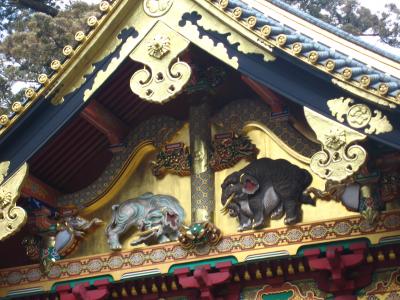
Interestingly, though, it wasn’t until way into the Edo period that the trees even arrived in Japan, so the above poem was based purely on imaginative transmission— like the wood carvings of elephants created at Nikko created by sculptors who had never seen such an animal.
And speaking of those blossoming lunar trees, in China, a beautiful young man 桂男-, who lives on the moon– was thought to be responsible for having planted the trees up there. The monster-loving Japanese, however, believed that the man on the moon was an incredibly elegant and handsome demon, and women were cautioned to never look too intently at the moon, otherwise the katsura-moon man would steal their souls! So beware!
**
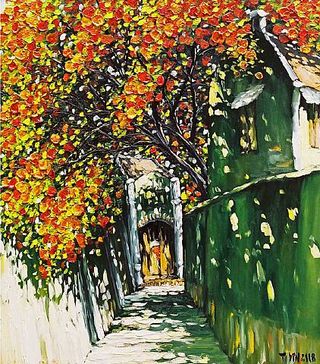
Painting top by Le Thanh Son.
Miki Minoru’s Autumn Fantasy below:
 Tang Dynasty Times