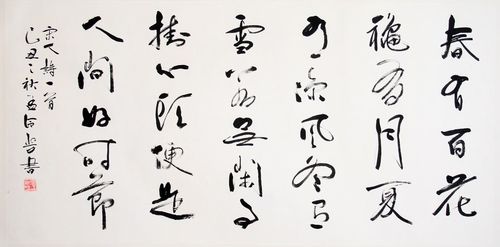
 春有百花秋有月,
便是人間好時節。
The dewy garden, then, is really a path leading one out of the everyday world of dust into a world where purity is valued aboveall:
露地はただ
浮き世のそとの
道なるに
心のちりを
にちらすらん
The roji is simply
a path leading from
this floating world.
Why bestrew it
with dust from the mind?
Sen Rikyu, Namporoku
My tea teacher once explained the words the famous Edo Period tea devotee, Matsudaira Fumai, who said that “Chanoyu is like a morning dewdrop poised on a seedling of rice” This is another way of expressing one of the most famous maxims of chanoyu: “this meeting- once in a lifetime” (ichigo ichie) which extols tea practioners to understand that every tea gathering is a once in a lifetime event, and therefore precious beyond value- very much like the beauty of the morning dew.
All this talk of dewdrops reminds me of a Vietnamese emperor. Bicycling around Hue on our broken-down peugeots, we trapsed into the Forbidden Purple City. It was so hot and I was hungry and tired, but sitting out by the small lotus pond behind the throne room, I overheard a guide telling a group of tourists that, “it was here that every morning servants gathered the dew that had collected overnight on the lotus leaves.” Why, we wondered would they collect the dewdrops? Before we could ask, the guide explained, the dewdrops were gathered to make the emperor’s morning cup of tea.
My heart skipped a beat– tea made from the water of dewdrops collected on the leaves of the lotus flowers: now that is something I would very much like to try someday….
If the mind thinks and the body moves, what is the function of the heart? According to Medieval philosopher, Ibn Arabi, the function of the heart is to imagine (what Henry Corbin calls “creative imagination”).
To me, this is a great insight about how one needs to live one’s life.
Rumer Godden, who lived on a houseboat on Lake Dal with her children and puppies– writing books and traveling extensively in India, said that a person is a house with three rooms. The room of the head, the room of the body and the room of the heart; and it is absolutely essential that one go into each of these rooms every single day—”even if just to dust.”
As Jung famously said, in the West we live exclusively in our heads. Many of us are cut off from the body– while most are cut off from the heart. This is what impressed Jung about India, for he thought that finally in India, he had found a place where body, mind and heart were functioning as equals. And indeed, for me, more than anything I was surrounded by what can only be described as overwhelming poverty, the people I encountered from Delhi to Ladakh seemed somehow happier than I ever would have expected (which is really to say, for all our wealth in the US, we don’t seem as happy and health as maybe we should be). Not to state the obvious, but happiness certainly doesn’t come from material things.
**
Namaste. Men and women throughout South Asia paint on a bindi up between their eyebrows every morning before they pray to signify the third eye of unconcealed “higher wisdom” (heart wisdom). Whenever Adonis sees a Buddhist statue in Japan, he always mutters, “What exactly is that third eye seeing?”
**
Just as one exercises body and cultivates mind, so must one cultivate heart. But how does one do that? Without imagination—the leap of imagination—belief in God and even love (true “falling in love” love) would hardly be possible.
Confucius instructed scholars to know the world by practicing a life of
読万巻書、行方里路
Reading 10,000 books/traveling 1000 miles
Just knowing the world was not enough, though. For Confucius also believed cultivation of the heart through the ancient Rites was essential.
***
Ever since I was a child, I cultivated certain places in my heart. Kashmir, Ladakh, Kenya, Kathmandu—now it is China. These places have drawn me to them in a way that is hard to explain. They were places I just felt I had to see, and seeing them—just as you would expect—I found exactly what I thought I would.
Joseph Needham, arriving in China after a decade of studying all things Chinese remarked:
Evereything seems so familiar– after having thought of China for so long. And yet, it is also like a dream
The truth is, when I think about the person that I am today, I realize that my experiences in those places (those places of my heart) have been essential in making me who I am today. Or to put it another way, I would probably not have developed into the same person, had I not traveled to those places that drew me to them so strongly. And, those places drew me in on the level of the heart (or as Ibn Arabi would put it, the imaginal realm).
Interestingly, some places, however, became “landscapes of the heart” after I actually went there. Of these places, of course Japan is the obvious one. It is a land that has changed me deeply. But that happened over many years only after I had arrived there. More surprising was Hong Kong—which was love at first sight. One of the few times in my life, in fact, that I truly fell in love. Like Borges, I keep a list in my heart of those things I love.
My list reads something like this: I love books, fine tea, fragrant essential oils and travel. Above all, however, I love Hong Kong.
**
I truly believe that if a person cultivates their heart, life can be led almost like an adventure. One just has to be open to what the heart is saying. Without a doubt, certain people and certain places hold meaning for us on our individual paths. Its something most mothers tell their children, but it bears repeating again: Follow your heart! The life of the heart is truly the only life worth living. And this is something very hard to keep in “mind” in the face of everyday material struggles– “getting ahead,” raising children and meeting work deadlines. This is, in fact, the real struggle.
Like a tidal wave obliviating everything in its path, the material everyday struggle can consume an entire lifetime leaving room for little reflection, contemplation or imaginings. In the end, though, it is only what is in the heart– or rather the travels of the heart– that truly matters.
 Tang Dynasty Times